






This is the first of a two-part series on the AI Red Queen race and what it could mean for companies, workers, and the social contract that holds them together.
There is a scene in Lewis Carroll’s Through the Looking-Glass where Alice runs as fast as she possibly can alongside the Red Queen. They sprint through an entire landscape, breathless, legs burning, and when they finally stop, Alice realizes they have not moved at all. She is exactly where she started.
“It takes all the running you can do, to keep in the same place,” the Queen explains, as if this were the most obvious thing in the world.¹
Carroll wrote this in 1871 as a piece of Victorian absurdity.
In 2026, it describes the corporate AI race with uncomfortable precision.
The official story
The narrative from boardrooms and conference stages is by now familiar. AI is a competitive weapon. Companies that adopt it first will be leaner, faster, and smarter than those that don’t. The logic is intuitive: if AI can handle coordination, reporting, analysis, and even parts of software development, then every role built around those tasks is open for redesign. Fewer managers. Fewer analysts. Fewer people doing work that a model can approximate in seconds.
Block’s Jack Dorsey has become the loudest voice in this chorus. In February 2026, he cut roughly 4,000 positions, about 40% of the company’s workforce, and framed it explicitly as an AI-driven restructuring. “Intelligence tools have changed what it means to build and run a company,” he wrote to shareholders. “A significantly smaller team, using the tools we’re building, can do more and do it better.”² On X, he went further: most companies would reach the same conclusion within a year.³
This is not one CEO’s experiment. McKinsey’s spans-and-layers methodology has long told Fortune 500 companies that 10 to 15% of management overhead is compressible.⁴ AI gives them the instrument to finally act on it. Amazon announced it needed “fewer layers.” Meta trimmed thousands. The consulting class has a new slide, and it says the same thing everywhere: flatten, automate, accelerate.
The case, on its own terms, is sound. The question is whether it leads where anyone expects.
The race nobody wins
Here is where the Red Queen enters.
When one company adopts AI to cut costs, it gains a temporary edge. When every company does it, the savings become the new industry baseline. The competitive advantage vanishes. What felt like a bold strategic move in 2025 becomes table stakes by 2027. Everyone is leaner. Nobody is ahead.
This is not speculation. It is the standard pattern of every previous wave of corporate technology adoption. When ERP systems swept through manufacturing and finance in the 1990s, early movers gained a real but brief advantage. Within a decade, every large company had SAP or Oracle, and the only lasting effect was that the minimum cost of doing business went up. Cloud migration followed the same arc in the 2010s. Early adopters saved on infrastructure. Then everyone migrated, and the savings disappeared into the new baseline.⁵
The Red Queen would recognize the pattern immediately. The race produces no lasting winners. It produces a new floor.
The race most companies have not even joined
And yet, even calling it a “race” overstates where most of the world actually stands.
A widely circulated visualization from early 2026 put the numbers in stark terms: out of 8.1 billion humans on earth, roughly 6.8 billion, or 84%, have never used AI at all. About 1.3 billion have tried a free chatbot. Somewhere between 15 and 25 million pay for a subscription. The number who use AI as a genuine working tool, with intent and skill, is vanishingly small.⁶
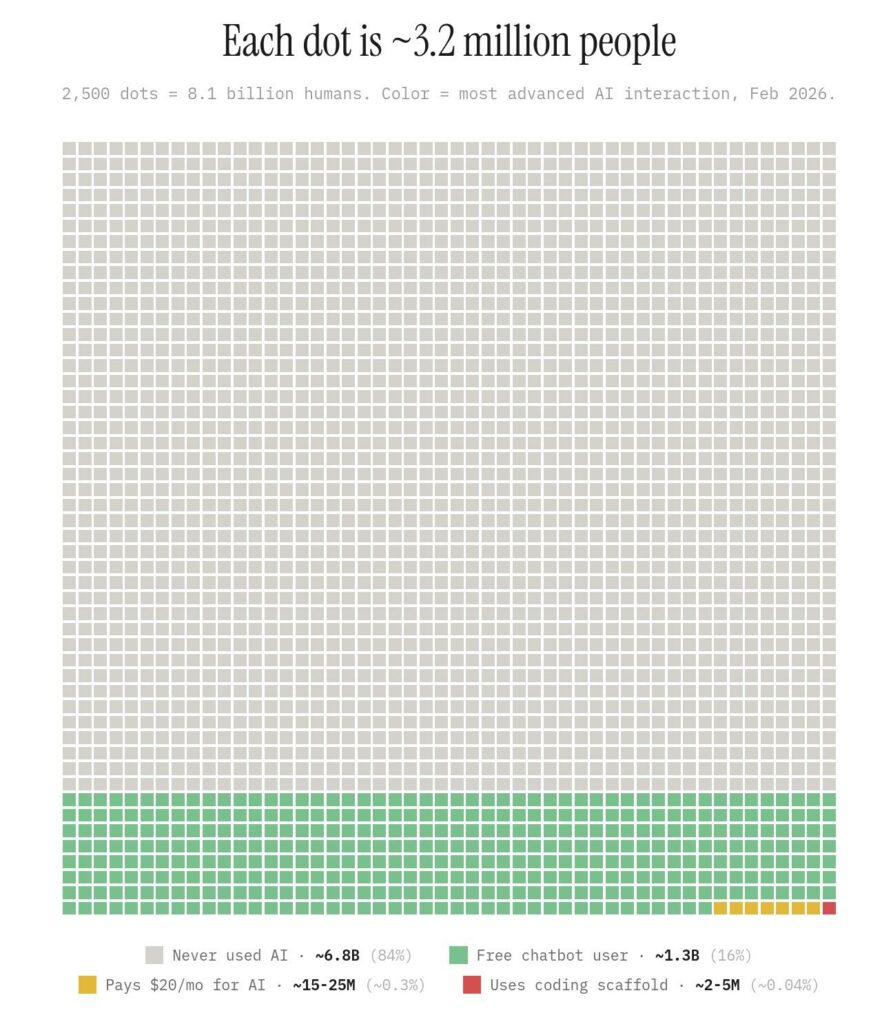
(Source ~ Damian Player)
The OECD’s own data confirms the picture at the enterprise level. In 2025, only 20.2% of firms across OECD countries reported using AI in any form. Among small firms, the figure was 17.4%. Even in the most advanced sector, ICT, adoption sat at 57%.⁷ Which means that across the broader economy, roughly four out of five companies have not meaningfully started.
But here is the more interesting number: among those who have started, what does “adoption” actually look like?
The theater of readiness
In most large organizations, AI adoption follows a pattern that would be familiar to anyone who has watched corporate change management before. A small group of enthusiasts, sometimes from IT, sometimes from a digital innovation team, gets on the AI train early. They experiment. They build demos. They run pilots. They present results to the executive committee. The board nods. A slide gets added to the quarterly deck.
The company now “has an AI strategy.”
Meanwhile, 95% of the organization has not changed a single workflow. The knowledge stays locked in that small task force. No training cascades down. No processes are redesigned. The handful of people who understand prompt engineering, who know that not all models are created equal, who have learned through trial and error that the way a question is framed determines the quality of the answer, remain a tiny cluster inside a vast structure that continues to operate exactly as it did before.
This is Goodhart’s law in real time.⁸ The measure of AI adoption (do we have a task force? did we present to the board? can we show a demo?) becomes the target. The actual outcome, whether the organization is genuinely more capable, becomes secondary. The company can honestly say “we are working on AI.” It cannot honestly say “we know how to use AI.” From the outside, and especially from the boardroom, those two statements look identical.
The readiness, by all available metrics, is excellent.
The three tiers
What emerges, then, is not a single race but three very different positions on the track.
The first tier is companies that have not started at all. Not the local bakery or the neighborhood restaurant, where AI is largely beside the point, but the thousands of service companies, consultancies, logistics firms, and mid-sized manufacturers whose core output is information, coordination, or process-driven work. For these companies, AI is not a competitive advantage to chase. It is a structural shift they have not yet registered. They are standing still on a track that is moving under them.
The second tier is the theater of readiness. The task force exists. The pilot ran. The board saw the slides. But the gap between “having people who use AI” and “being an AI-capable organization” remains enormous. These companies look like they are running. They are not. And this is the most dangerous position of the three, because it combines the costs of adoption, the budget, the disruption, the raised expectations, with none of the actual capability.
The third tier is the small minority that has genuinely integrated AI into workflows, decision-making, and production. These are the companies entering the real Red Queen race. They are running. And as every wave of technology adoption before this one has shown, they will run faster and faster, and the distance between them and their competitors will shrink to zero, because their competitors are running too.
The floor that keeps rising
This is the structural problem that neither the AI evangelists nor the change-management consultants are willing to state plainly. If a company does not adopt AI, it risks irrelevance. If it does adopt AI, it enters a race that, by definition, produces no lasting advantage. The first position is fatal in the medium term. The second is a treadmill.
And the treadmill does not only apply to companies. It applies to every person inside them.
The developer who used to be excellent at fifty lines of clean code per day now competes against a colleague who ships two hundred with AI assistance. The analyst whose value was in building complex Excel models watches a junior colleague produce comparable output in a fraction of the time. The content team that once needed five writers finds that two writers with AI tools can match the volume. The bar rises for everyone, at every level. The output expected goes up. The reward stays the same.
Which brings us to a question that almost nobody in the current AI discourse is asking, and that cuts deeper than any restructuring plan.
If AI can do what we do, then what, exactly, are we?
In Part II, we will look at what happens when that question hits an entire workforce, and why the answer might determine whether the social contract that holds the corporate world together can survive.
References
- Carroll, L. (1871). Through the Looking-Glass, and What Alice Found There. Chapter 2.
- Block, Inc. Form 8-K, Shareholder Letter, February 2026. https://www.sec.gov/Archives/edgar/data/0001512673/000119312526212032/d132441dex991.htm
- CNN Business, “Block lays off nearly half its staff because of AI,” February 27, 2026. https://www.cnn.com/2026/02/26/business/block-layoffs-ai-jack-dorsey
- McKinsey & Company, “How to identify the right spans of control for your organization.” https://www.mckinsey.com/capabilities/people-and-organizational-performance/our-insights/how-to-identify-the-right-spans-of-control-for-your-organization
- Historical ERP/cloud adoption curve: the pattern is well-documented across industry analyses. https://www.researchgate.net/publication/328435569_Prioritizing_the_factors_affecting_cloud_ERP_adoption_-_An_Analytic_Hierarchy_Process_approach
- Visualization by @NoahEpstein_ (X/Twitter), February 2026. Underlying data: ChatGPT reported 400M monthly active users (OpenAI, February 2025); global population 8.1 billion (UN estimate).
- OECD, “AI use by individuals surges across the OECD as adoption by firms continues to expand,” January 2026. https://www.oecd.org/en/about/news/announcements/2026/01/ai-use-by-individuals-surges-across-the-oecd-as-adoption-by-firms-continues-to-expand.html
- Goodhart, C. (1975). “Goodhart’s Law” (originally: “Any observed statistical regularity will tend to collapse once pressure is placed upon it for control purposes”). Widely cited in organizational theory; see Strathern, M. (1997), “‘Improving ratings’: audit in the British University system,” European Review, 5(3), 305–321.